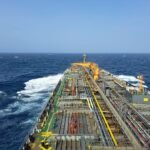
The gasoline and heating fuel you buy are priced off global crude, and part of that crude moves through one narrow waterway. In the week ended Oct. 14, 2026, 131 vessels crossed the Strait of Hormuz, down from 176 the week before, according to maritime analytics firm Kpler, as reported by CNBC on Oct. 16, 2026. Crude exports through the strait stood at 9.4 million barrels a day that week, about 70% of the average before the Iran war, per Kpler data cited by CNBC.
Why ships are steering clear of a key oil route
Two Singapore-flagged container ships were attacked this week, CNBC reported. GFS Pride sank after being struck by a projectile and catching fire, and GFS Giselle was damaged. Crew members from both ships were reported safe. U.S. Central Command said Iran sank GFS Pride, and Singapore’s maritime authority said its crew was safely evacuated. At least nine tankers and cargo ships have been attacked near Hormuz since Sunday as Iran tries to choke off oil exports through the waterway, CNBC reported. The International Maritime Organization counts three seafarers injured and two missing. Kpler says the drop in crossings cannot be attributed solely to the latest incidents. Major container lines are largely staying away, but maritime experts told CNBC that strong demand for Middle Eastern energy and lucrative shipping opportunities keep some operators willing to transit. Collin Koh, a senior fellow at Singapore’s S. Rajaratnam School of International Studies, said Singapore-flagged ships are unlikely to avoid the transit in the short term if there is an opportunity. Dimitris Ampatzidis, maritime risk and compliance manager at Kpler, said the attacks underscored Iran’s continuing ability to threaten commercial vessels, with risks extending beyond oil and gas transport.
Follow the barrels: from fewer crossings to tighter supply
The chain runs step by step. Fewer ships crossed the strait: 131 in the week ended Oct. 14 versus 176 the week before, according to Kpler. Crude exports through Hormuz had touched pre-war levels in September before pulling back to 9.4 million barrels a day, per Kpler. On Oct. 16, Brent crude hit $110 a barrel for the first time since May and closed at $109.86, up 3.7%. U.S. benchmark WTI settled at $101.41, up 3.5%. Over the week, WTI gained more than 10% and Brent nearly 5%, CNBC reported. CNBC tied those moves to three pressures at once: the Hormuz attacks, Houthi strikes on Saudi Arabia, and Ukraine’s vow to keep hitting Russian refineries. It does not say how much of the rise comes from Hormuz alone.
Our math: sizing the missing barrels
This illustration uses Kpler’s figures and is not a new estimate. The drop in crossings is 176 minus 131, or 45 ships. That is 45 divided by 176, about 26% in one week. If 9.4 million barrels a day equals about 70% of the pre-war average, the pre-war pace was 9.4 divided by 0.70, or roughly 13.4 million barrels a day. That puts the current shortfall at 13.4 minus 9.4, or about 4 million barrels a day. For households, these are barrels that are not reaching the global market, where gasoline prices are set. The source gives no figure for how much this gap adds to the price of a gallon at the pump.
What to track this week
Watch Kpler’s next weekly crossing count and crude export figures to see whether flows keep falling or recover toward pre-war levels. Track Brent and WTI prices, since the crude price is a major input to the gasoline and heating costs a typical household pays. Also watch whether attacks near Hormuz and on Saudi Arabia continue, and whether major container lines resume transits through the strait. Sources: CNBC. Disclaimer: This analysis is for educational and informational purposes only and should not be construed as financial or investment advice.