
Enjoying this? Get one story like this in your inbox every morning — free, 2-minute read, zero spam.
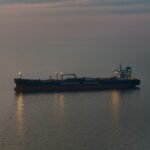
Photo by Mauricio Krupka Buendia on Pexels
⏱️ 3 min read
Why does a tanker attack half a world away change what you pay to fill your tank? Brent crude, the global oil benchmark, traded at $109.73 a barrel as of 3:33 a.m. ET on Wednesday, Oct. 21, 2026. That was up 0.86% on the day, according to CNBC. Fortune’s Oct. 20, 2026 explainer says crude oil often makes up more than half the cost of a gallon of gasoline. It also says that when oil prices jump, gas prices usually climb right along with them, while they often fall much more slowly.
Mines and Missile Strikes Push Oil Higher
Iran’s Revolutionary Guards said Tuesday, Oct. 20, that naval mines had stopped three tankers trying to pass through the Strait of Hormuz on routes Tehran deemed unauthorized. In a statement on the Guards’ Sepah News website, reported by CNBC, they said two tankers were set ablaze. On Monday, Yemen’s Houthi militants claimed strikes on Saudi Aramco facilities in Yanbu, the Shaybah oilfield and airports in Riyadh and Abha, CNBC reported. RTTNews reported that Asian markets traded mostly lower on Tuesday. It said elevated oil prices, amid hostilities in the Middle East and Eastern Europe, heightened global inflation concerns and pushed global bond yields higher. Russia and Ukraine have also resumed attacks on energy infrastructure, RTTNews said. West Texas Intermediate, the US benchmark, rose 0.78% to $98.58 a barrel at the same time Wednesday, per CNBC.
From a Mined Shipping Lane to a Refiner’s Margin
The tensions have also raised the cost of moving oil. A Goldman Sachs report published Tuesday, Oct. 20, found that the global average crude freight rate has surged above $20 a barrel, compared with $3 a year earlier, as reported by CNBC. Rates have eased slightly in recent days but remain roughly seven times higher than a year ago. According to CNBC’s account, Goldman estimated that war-risk premiums for crossing the Strait of Hormuz account for about $7 of the year-on-year increase. Ship-to-ship transfers outside the Persian Gulf contributed another $4. Goldman warned that higher shipping costs could widen price gaps between crude grades and squeeze refiners’ profit margins. It said they could ultimately push up refined fuel prices, the category that includes the gasoline you buy. CNBC’s report gives no pump-price figure.
Our Math: How Big Is Freight in a Barrel?
Here is an illustration, not a forecast. The rise in freight is the new rate minus last year’s rate: $20 minus $3 equals about $17 a barrel. The freight share of Wednesday’s Brent price is the freight rate divided by the Brent price: $20 divided by $109.73 equals about 18%. The year-on-year rise in oil itself is the current price minus the year-ago price, using Fortune’s Brent data as of 8:15 a.m. ET on Oct. 20. That is $112.85 minus $61.25, or $51.60, an 84.24% increase. Brent was also up 8.24% from $104.25 a month earlier. The source gives no figure for how much of the freight increase reaches the price of a gallon at the pump. Refining, wholesaling, taxes and station markups also shape what you pay, according to Fortune.
Checking Your Own Numbers This Week
Compare the price on your local station sign with the Brent and WTI levels above, and remember that pump prices tend to follow oil up faster than down. Watch for further developments at the Strait of Hormuz and any update to Goldman Sachs’ freight-rate estimates, which could change the math here. Fortune notes that the US Strategic Petroleum Reserve can help cushion supply shocks during crises, though it is not meant to solve long-term problems. Sources: CNBC, Fortune, RTTNews. Disclaimer: This analysis is for educational and informational purposes only and should not be construed as financial or investment advice.
Sources: CNBC, Fortune, RTTNews